 Faith
Faith
7 Linen Textures That Turn Any Room Into a Sacred Space
# 7 Linen Textures That Turn Any Room Into a Sacred Space
**Disclosure:** This article contains affiliate links. If you purchase through our links, we may earn a small commission at no extra cost to you. We only recommend products we believe in.
Sacred space is not a building. It is a quality of attention. And texture — the feel of things, the weight of cloth, the patina of natural fabric — is one of the primary languages through which a home speaks that quality. Linen, in particular, carries something that synthetic fabric cannot: the record of a plant becoming cloth. It carries the sun, the rain, the hand that wove it. When you fill a room with linen, you fill it with that much more of the created world.
Here are seven linen textures and what each one does to a room.
## 1. Washed linen — the quiet revolution
Washed linen is linen that has been pre-washed repeatedly until it loses its stiff, papery quality and becomes soft, almost textured. It drapes the way you want things to drape. It holds light the way old linen in European farmhouses always held light — with a warmth that synthetic fabric simply cannot reproduce.
Use it for: bedding, curtains, loose throw blankets folded over a chair. A washed linen duvet cover is one of those things that changes how you feel when you walk into your bedroom. Not because of the look, though it is beautiful. Because of the feel when you lie down in it.
## 2. Stonewashed linen — deliberate softness
Stonewashing uses ceramic stones in the washing process to accelerate the softening. The fabric comes out with a slightly uneven tone — minor variations in color that create the impression of age and authenticity. This is not a flaw. It is the look.
Use it for: table linens, napkins, pillow covers. A table set with stonewashed linen napkins tells guests: this is a house that uses its things. That understands quality. That has settled into itself.
## 3. Herringbone linen — the pattern that holds
Herringbone is a weave pattern — a series of V shapes reversed back and forth, creating a diagonal texture. It is used most traditionally in tweeds and suit fabrics, but when woven into linen, it becomes a quiet structural element in home textiles.
Use it for: heavier draping applications — curtains, light upholstery panels, decorative pillows in living rooms. Herringbone linen absorbs light differently at different angles, so it looks different in morning versus evening. It is a living pattern.
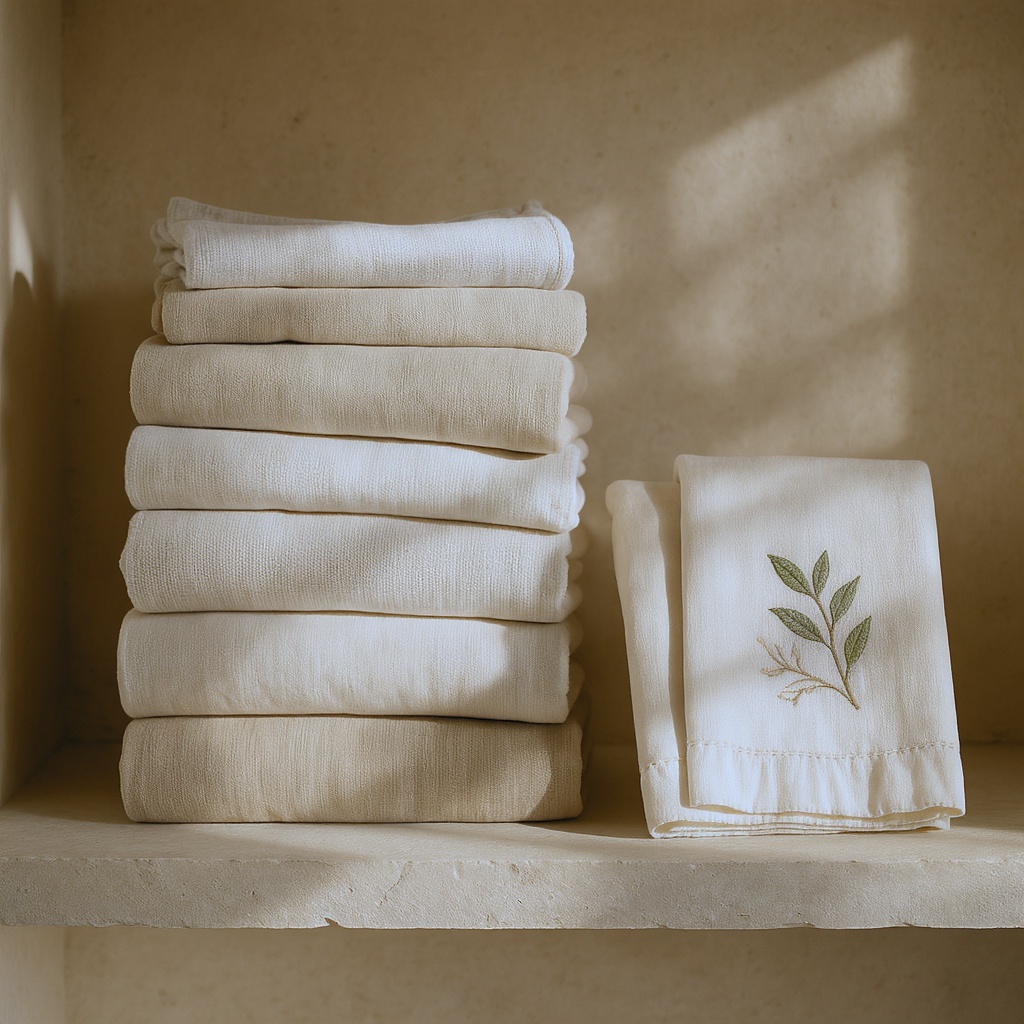
## 4. Linen with embroidery — the human mark
Linen that has been hand-embroidered carries something machine-made fabric cannot: the record of time and attention. Even simple monograms or small floral borders on a linen napkin or pillowcase create a quality of being made specifically for this place.
Use it for: pillowcases, table napkins for the dining table you actually use, hand towels in a guest bathroom. A hand-embroidered initial on a linen hand towel is one of the most underrated acts of hospitality.
## 5. Raw linen — the honest fabric
Raw linen is linen that has been processed minimally — it retains the visible slubs and irregularities of the unbleached fiber. It is rough to the touch at first. It wrinkles aggressively. It is the most honest textile you can put in a home.
Use it for: table runners, curtain panels, cushion covers in spaces you want to feel grounded. Raw linen develops beautifully over time — the more you wash it, the softer it becomes. It ages toward itself.
## 6. Linen-cotton blend — the practical anchor
Not everything in a sacred space has to be pure linen. A linen-cotton blend — typically 55% linen, 45% cotton — gives you most of the texture and warmth of linen with better wrinkle resistance and a lower price point.
Use it for: children's spaces (where pure linen would be too precious), everyday table linens, larger curtain panels where the weight of pure linen would be excessive.
## 7. Linen velvet — the unexpected depth
Linen velvet is woven from linen fibers but finished to create the soft, light-absorbing pile of velvet. It has none of the synthetic slickness of some velvets. It is warm to the touch and creates extraordinary depth in darker spaces.
Use it for: a statement chair, a bedroom accent pillow, a draped throw at the foot of a bed. Linen velvet is underused — it is one of the most beautiful textiles available for home use, and it tends to be less expensive than wool or silk velvet.
## The underlying principle
Linen works in sacred space because linen is itself a kind of metaphor — something made from the earth, processed by time and water, and arrived at through patience. A room full of linen is a room that has been thought about. A room that has been curated with attention to what actually matters: texture, warmth, authenticity, the presence of things that will still be beautiful in twenty years.
Start with one piece. Add the next when you can. Watch how the room begins to hold you differently.
Live This
Products We Love
Curated picks we actually use — linked for your convenience.
TikTok Shop
Natural Linen Table Runner
Stonewashed linen in natural oat — soft from the first touch, with the slightly uneven tone that tells you it has been washed and loved. Sets the foundation for a room that holds you differently.
From $32
Coming Soon
TikTok Shop
Handwoven Linen Cushion Cover Set
A set of two linen cushion covers in complementary natural tones. Raw linen that softens over washes — the kind of textile that records a home's seasons in its texture.
From $45
Coming SoonFree 7-Day Guide
Get the Sanctuary Starter Guide
Seven daily practices across Faith, Health, Serenity & Intentional Living — free PDF, delivered instantly.
Free. No spam. Opt out anytime.